
Search
Upcoming Workshops
- PRIVATE EVENT(2 days)
- Workshop: Make Safe and Effective Bug Spray at Karma Coop(11 days)
- Conscious Minds Youth Camp Elder(29 days)
- Herbal Wizard Tracey Gaming and Fantasy Weekend at Camp Naivelt(58 days)
- Camp Nailvelt Creative Week: Tracey Facilitates Craft Workshops(61 days)
- Camp Naivelt: Live Action Role Play with Tracey as Bubbe Mirele(66 days)

Calendar of Workshops & Events
User Login
Navigation
Anarres and the Ethics of Using Dead Sea Salts and Muds
I Discontinued Dead Sea Salts.
I decided to stop carrying Dead Sea salts due to the lack of local availability of Dead Sea products from Jordan and the high cost of importing them myself. For environmental reasons, it is important to source Dead Sea products from Jordan rather than Israel or the Occupied West Bank. As a replacement, I am now offering Mediterranean Sea Salt, which is locally sourced and rich in minerals. You can find more information about Mediterranean Sea Salt here.
Furthermore, I still carry Himalayan Pink Rock Salt, which is ethically sourced from India (not Tibet). You can learn more about Himalayan Pink Rock Salt here.

Why Jordanian Dead Sea Products Are Ethical
I believe that the Dead Sea products from Jordan are the most ethical on the market, and here are the reasons:
- Environmental Management: Among the three countries that border the Dead Sea (Israel, West Bank, and Jordan), Jordan has the best environmental management plan for the Dead Sea. Presently, it is not the subject of human rights concerns.
- Mineral Evaporation Ponds: The mineral evaporation ponds at the southern tip of the Dead Sea are primarily created and maintained for extracting industrial minerals, not sea salts. The production of Dead Sea Salts, which are therapeutic but not edible, is relatively small.
- Receding Shoreline: The receding shoreline of the Dead Sea is caused by factors such as global warming, the diversion of water for drinking purposes, and irresponsible industrial activity. It is not directly related to the extraction of salts. Jordan has plans to address this situation. You can read more about Jordan's plans here.
I invite you to comment below by offering your concerns, opinions, or new information.
Industry
In the early 20th century, the Dead Sea attracted interest from chemists who discovered that it was a natural deposit of potash and bromine. The Palestine Potash Company was established in 1929 and became the largest industrial site in the Middle East. It produced potash through solar evaporation of brine. However, the company was eventually affected by the 1948 Arab-Israeli War. Dead Sea Works Ltd., a state-owned company, was established in 1952 to extract potash and other minerals from the Dead Sea.

The southern half of the Dead Sea is now separated from the northern half at what used to be the Lisan Peninsula because of the fall of the level of Dead Sea.
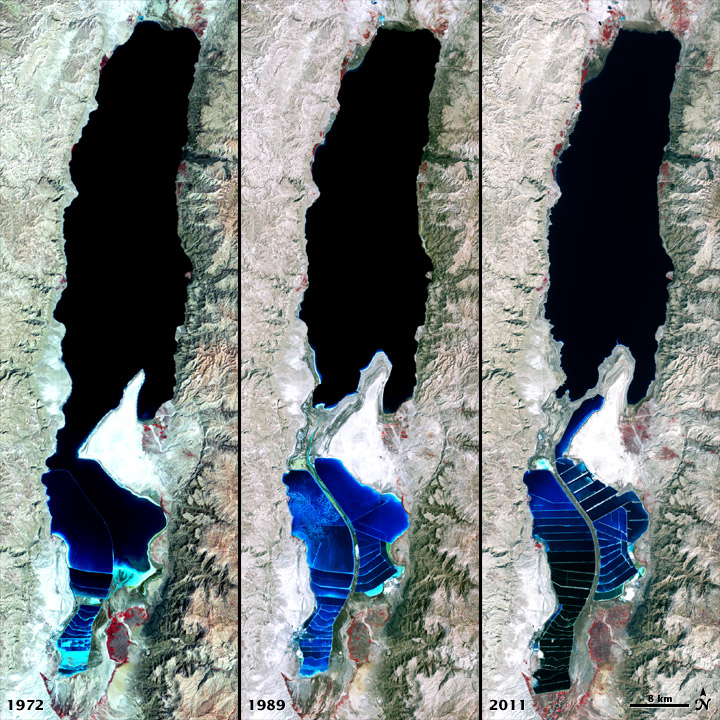
Israel and Jordan both have extensive salt evaporation pans that produce various minerals from the Dead Sea. Several companies have also shown interest in manufacturing and supplying Dead Sea salts for body and skin care products due to their therapeutic and healing properties.
Recession and Environmental Concerns
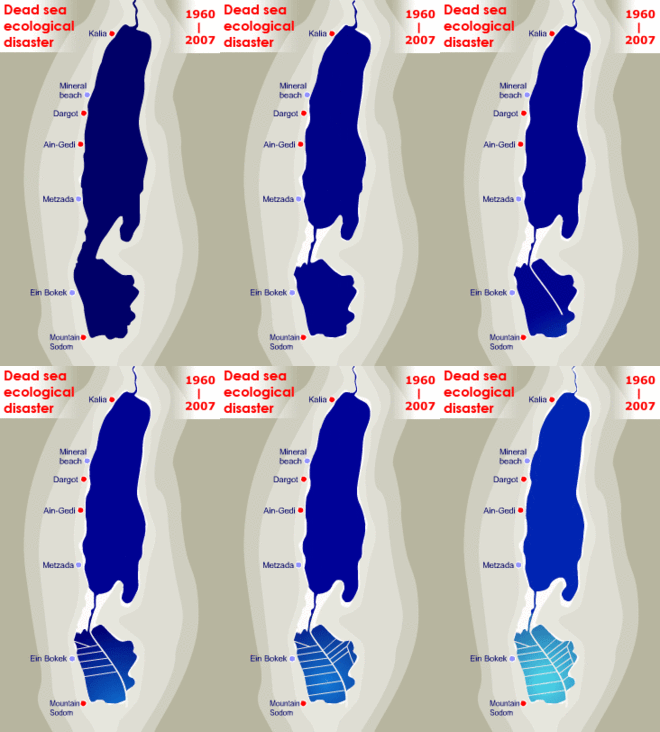
The Dwindling Water Level of the Dead Sea
In recent decades, the Dead Sea has been rapidly shrinking due to the diversion of incoming water from the Jordan River. The southern end is fed by a canal maintained by the Dead Sea Works, a company that converts the sea's raw materials. The water level has dropped significantly, causing changes in the characteristics of the sea and the surrounding region.
The drop in the Dead Sea level has also led to a decrease in groundwater levels, resulting in the flushing out of brines by freshwater. This has caused the emergence of large sinkholes along the western shore as salt layers are dissolved by incoming freshwater, creating subsurface cavities that collapse over time.
In response to the shrinking Dead Sea, Jordan announced the "Jordan National Red Sea Development Project" (JRSP) in 2009. The project aims to convey seawater from the Red Sea to the Dead Sea, desalinating the water for freshwater supply and replenishing the Dead Sea with the brine discharge. The project is still in its planning stages, with expected water delivery by 2017. Some concerns have been raised about the potential environmental impact of the project.
At a regional conference in July 2009, officials expressed increased concerns about dropping water levels and discussed measures to restore conditions, including increasing flow from the Jordan River, implementing strict conservation efforts, and reducing pollution sources. Experts also asserted a need for strict conservation efforts - that agriculture should not be expanded, sustainable support capabilities should be incorporated into the area and pollution sources should be reduced.[25]
For more detailed information, you can refer to the related sources provided at the end of this post.
Related Wikipedia Entries on the Dead Sea
You can find more information about the Dead Sea in the following Wikipedia entries:
# ^ staff writer, ArabianBusiness.com (2007-05-22). "Jordan's Dead Sea Comes to Life". Arabian Business. http://www.arabianbusiness.com/property/article/12982-jordanian-secret. Retrieved 2008-11-02.
# ^ C. Klein, A. Flohn, Contribution to the Knowledge in the Fluctuations of the Dead Sea Level. Theoretical and Applied Climatology, vol. 38, p. 151–156, 1987
# ^ M. Abelson, Y. Yechieli, O. Crouvi, G. Baer, D. Wachs, A. Bein, V. Shtivelman. "Evolution of the Dead Sea Sinkholes", in New Frontiers in Dead Sea Paleoenvironmental Research, Geological Society of America, special paper 401, p. 241–253, 2006
# ^ Jordan to refill shrinking Dead Sea Daily Telegraph 13 October 2009
# ^ Back from the Dead?, Ehud Zion Waldoks, The Jerusalem Post, July 8, 2009.